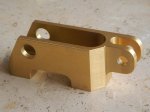
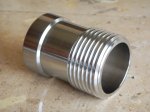
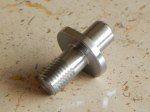
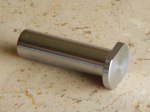
Anodizing and Plating Success

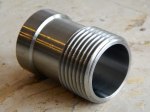
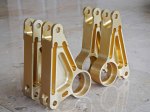
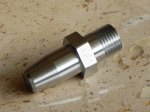
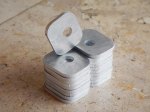
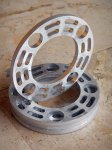
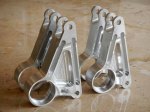
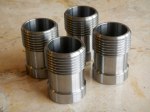
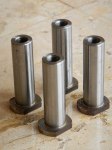
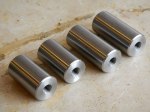
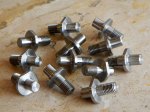
Found a supplier of anodizing and plating services up in Chonburi called Thai Silvec. I kind of got the impression they’d never had someone just walk in the front door with parts that needed plating and anodizing, but they accommodated me just fine. Very serious Japanese management, everything organized and clean, and reasonable prices. They gave me a detailed quality report when they delivered the parts, so now I know just how much allowance to leave for plating a mating parts. For next time, that is. This time around, I’ve had to do a lot of hand work to get everything to fit due to the stack-up of plating and anodizing thicknesses. At least I had them mask the wheel bearing bores, so the bearings later pressed in smoothly.

First Laser-Cut Parts

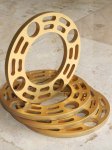
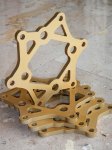
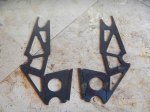
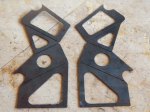
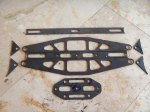
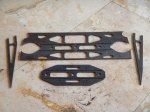
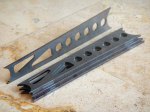
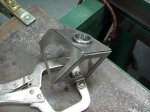
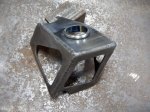
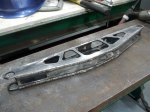
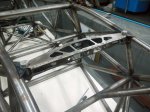
Below is our proof-of-concept for laser cutting parts in Thailand. Choices of material are extremely limited– ya got yer steel, see, and ya got yer aluminum. Unfortunately the aluminum is 1100, which has the structural strength of mozzarella, so I had to provide my own 6061-T6 to be cut. That didn’t reduce the price much, though. Redesigned some parts to match the available steel, which luckily is considerably stronger than cheese. I don’t yet have a sheet metal bender or supplier, so some parts have a slot cut where they are bent by hand and welded to shape as seen in the last photographs.

Part Eleventy-seven, In Which We Finally Lay Up a Body

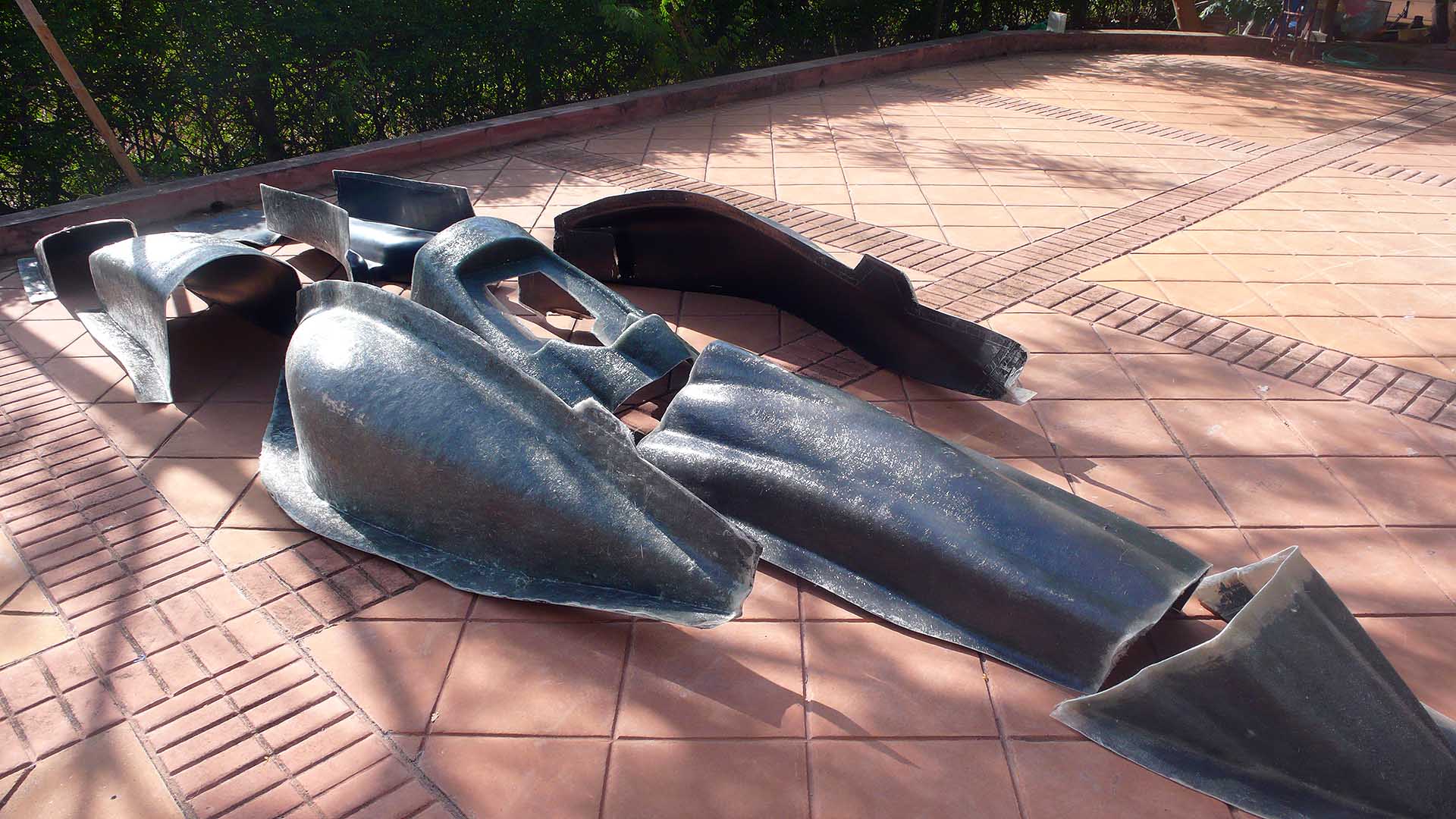
Finished Body

Another view of finished main body.

Time to lay up the first set of body panels. In some photos you can see the joggles laid into the molds with duct tape so the panels will overlap smoothly. Nine coats of mold release wax and there were no problems releasing parts from the molds, although at times I did have to work a bit. Each mold required about a day of finishing work to remove ripples due to waviness in the body buck. As I’ve said before, don’t build a body buck the way I did it. Instead, immediately after completing the X-Y grid of cross sections, lay about 3mm of fiberglass on top to give a good solid surface, then use body putty on top of that. You’ll be finished in half the time it took me. The only place you should use foam is where actual carving is required due to the complexity of the shape, like the sidepod air inlets. Yes, I know the main roll hoop forward braces are still not there. Patience…

One problem I found out the hard way is that a chemical in some brands of duct tape inhibits gelcoat curing. In the end, gelcoat that had been in contact with some kinds of duct tape never fully cured and had to be cleaned out with acetone. Also, the joggles formed with duct tape were too sharp for the fiberglass mat to conform to, resulting in bubbles under the gelcoat that have to be scraped out and reworked. Gelcoat is probably more trouble than it’s worth given its weight, so next time I’ll just prime and paint the body panels to finish them. The sharp joggle corners need to be filled in with fiberglass roving before laying mat on top.

Last of the Molds

Mold Set

Completed set of molds

Since this is the last of the molds, in the photos below I’m showing each of the layups, for a total of three. Target thickness for the molds is 4.8mm, three times the expected thickness of the parts to be molded.

Fiberglass Mold Layup, Parts 4, 5, 6…

Probably the main thing to explain here is how I create the overlaps in the molds. The edge of a mold is marked on the body buck with duct tape, which will leave an impression in the mold for later trimming of the finished part. Then after removing the mold from the buck, I lay in a strip of 1″ duct tape touching the existing tape, then another strip touching that one. I then remove the first two strips of tape, leaving the edge for the next mold with a 1″ overlap.

Fiberglass Mold Making- Nose, Tail, Sidepod

Time to make molds!

First CNC Parts, Class Photos

Uprights

Suspension uprights, two left, two right

Getting caught up on my blogging…

Shiny Happy CNC Parts

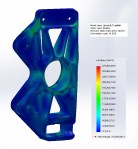
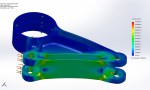
I’m getting some interest in the car from here in Thailand, but they want it SOON. So I’ve had to step up the rate of progress, even though it hasn’t showed here on the blog. Instead, I’ve been designing and designing and designing… It’s a big step from an assembly design that seems pretty much correct, to a set of drawings and IGES or DXF files that you’re willing to pay real money to fabricate. Everything has to be checked, from the load cases used in the finite element analysis to the hole clearances for every bolt.

For example, did you know that a 1/4″ bolt doesn’t go into a 1/4″ hole? The proper size of the hole is 0.257″ for a close fit or 0.266″ for a free fit. Of course, then you have to take into account the width, or kerf, of the laser beam used to cut the metal, which can be 0.01″ or 0.25mm but varies with the type of material and thickness being cut, and the laser beam is actually a cone that can be focused on the top, middle, or bottom surface of the piece. Many parts had to be redesigned for the materials and processes I’ve been able to locate in Thailand. Here it’s not a simple matter of looking up all the local suppliers on Google and giving one a call. Thailand has a great number of very small companies that rarely have websites, and even if they exist they’re mostly in Thai, which as a special favor to web search engines uses no spaces between words. Yes, you read that right. Using no spaces would be OK if there were only one way to parse a stream of Thai characters, but haha, you make joke, eh? And then if I can actually get someone on the phone, I have to communicate in Thai. Like that’ll work.

Last year I was looking for a foundry to cast aluminum uprights, and I found one (using Startpage, not Google) less than an hour from here. Their website had a Google map and everything! So I drive there, and I’m within 100 feet or so, asking motorcycle taxi drivers where the company is. No idea; there’s never been a foundry around there. I show them the address and they say oh, that’s way over on the other side of town. The person answering the phone number has no idea what I’m talking about. I give up.

On the other hand, recently one of those Google ads that look like the first links on your search actually showed me something that I needed and couldn’t find with a search: a small local company that fabricates custom radiators. So I managed to find their shop this week and got a quote for the radiator. Quote comes by email entirely in Thai. Google translate does a pitiful job of translating Thai, but I caught on the email wasn’t spam. Fantastic price, by the way. Cheaper than what I paid for a used race car radiator on EBay. I decided I didn’t really like how that one would fit, so I designed one that’s ideal for my application and figured I’d worry about fabrication later. Problem solved, yay!

The Thai racers who are interested in the project have emphasized that the price is crucial, which means more redesign. Surprisingly for me, this is the same thing I’ve heard from the people in Singapore who’ve contacted me. Sometimes it’s easy to dash off a quick machined aluminum design, but it takes a lot more thinking to do it with laser-cut steel pieces. The equivalent in steel typically ends up being a little heavier, but that’s an example of why Formula 1000 has a minimum weight rule. Laser-cut steel hand-welded into a complex component is just about free in Thailand.

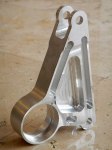
Where before I was planning on making just about everything in my machine shop, now I’m looking at fabricating as much as possible at subcontractors. Luckily a friend found a large CNC machine shop not too far from here, and the guy running it speaks English and understands drawings and computer files and tolerances and clearances and everything. I’ve now received my first batch of CNC machined parts from them and they look great. Combined with the first batch of laser-cut parts and a few parts I’ll fabricate and modify myself, I now have everything to make the car a roller.

Anyway, on to today’s gallery:

Finishing the Body Master Pattern

I ended up applying ten coats of SikaFloor epoxy to try to build a hard base for further finishing. Even this gave me problems, though, as it appears that the two-part urethane foam continues to expand indefinitely. Every time I would finish a section, next time I looked at it, it needed more work. For a long time I just thought my eyes were getting more demanding, but I finally realized the body buck was slowly changing shape, bulging out between the ribs. Once I figured this out, I just tried to finish the molds as fast as possible. I also installed air conditioning in this part of the workshop, and kept it running at night to avoid temperature-cycling the pattern.

If you’re thinking of doing this yourself, a better way to do it would be to just fiberglass straight over the plywood forms, using tape or something to support the first layer of fiberglass while curing. About a 3mm fiberglass shell should do it. Then use body putty right over that, using standard auto-body finishing techniques. That way there’s no foam between the ribs to push outward and mess up the shape. The only time you need foam is when you’re really sculpting something, like the sidepod air intakes. Oh, by the way, plan on about 1,000 hours of work.

After the floor epoxy there were several rounds of primering, puttying and sanding, followed by two coats of black two-part epoxy paint. This was sanded with 400, 800, 1200, and 2000 grit wet-or-dry sandpaper, then machine-polished with rubbing compound. The top layer was 9 coats of “Hi Temp Mold Release”, applied by hand strictly according to the instructions.

When I started to think about how to split up the body panels, I realized that the “horse collar” head surround would be impossible to remove when the car was finished, as it would interfere with the main roll hoop. This necessitated going all the way back to the SCCA rule book, where I took another look at the minimum cockpit opening specifications. I found that I could meet the minimum cockpit opening size with a fixed head surround, but I had to cut the “arms” off it. So, you get to see that surgery in the photos below.