Building the Axle Halfshaft Extensions


Rear Suspension

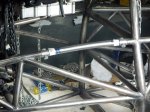
Rear suspension, axles and differential in place

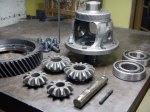
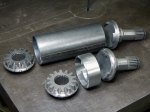
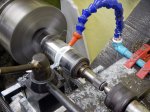
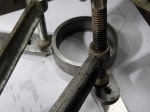
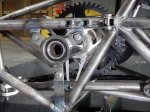
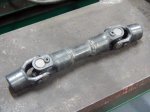
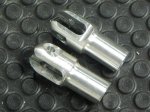
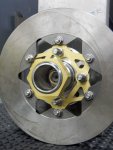
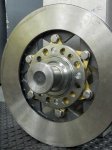
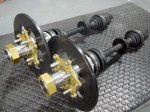
The car will use standard Honda Civic axle halfshafts, and I had the choice of cutting, sleeving and re-welding them, or building extenders that effectively widen the differential to meet the unmodified halfshafts. The cut/sleeve/re-weld option would eliminate the axle hardening and leave unknown strength, and I’ve since seen an example where this was done and the axle broke right at the weld. The option of “widening” the differential has several advantages. First, we can easily replace the halfshafts if necessary in the future with off-the-shelf parts. Second, moving the inner constant-velocity joint closer to the plane of the control-arm pickup points minimizes the plunge, or change in length, required as the suspension moves through its travel. Third, the halfshafts become equal length, eliminating torque steer. Now you may say “but, the extensions will be of different length and will twist unevenly so the torque steer won’t be eliminated”. The extensions will be much stiffer than the axle shafts so that won’t be the case.

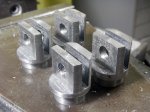
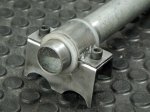
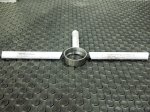
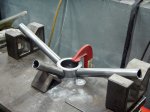
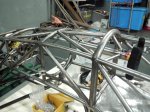
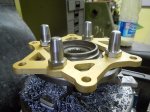
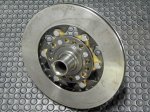
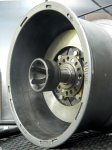
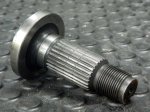
So the choice was clear. We started with a differential and a couple of halfshafts as raw material…


Mounting the Rear Sprocket

Mounted

Rear sprocket mounted on the differential

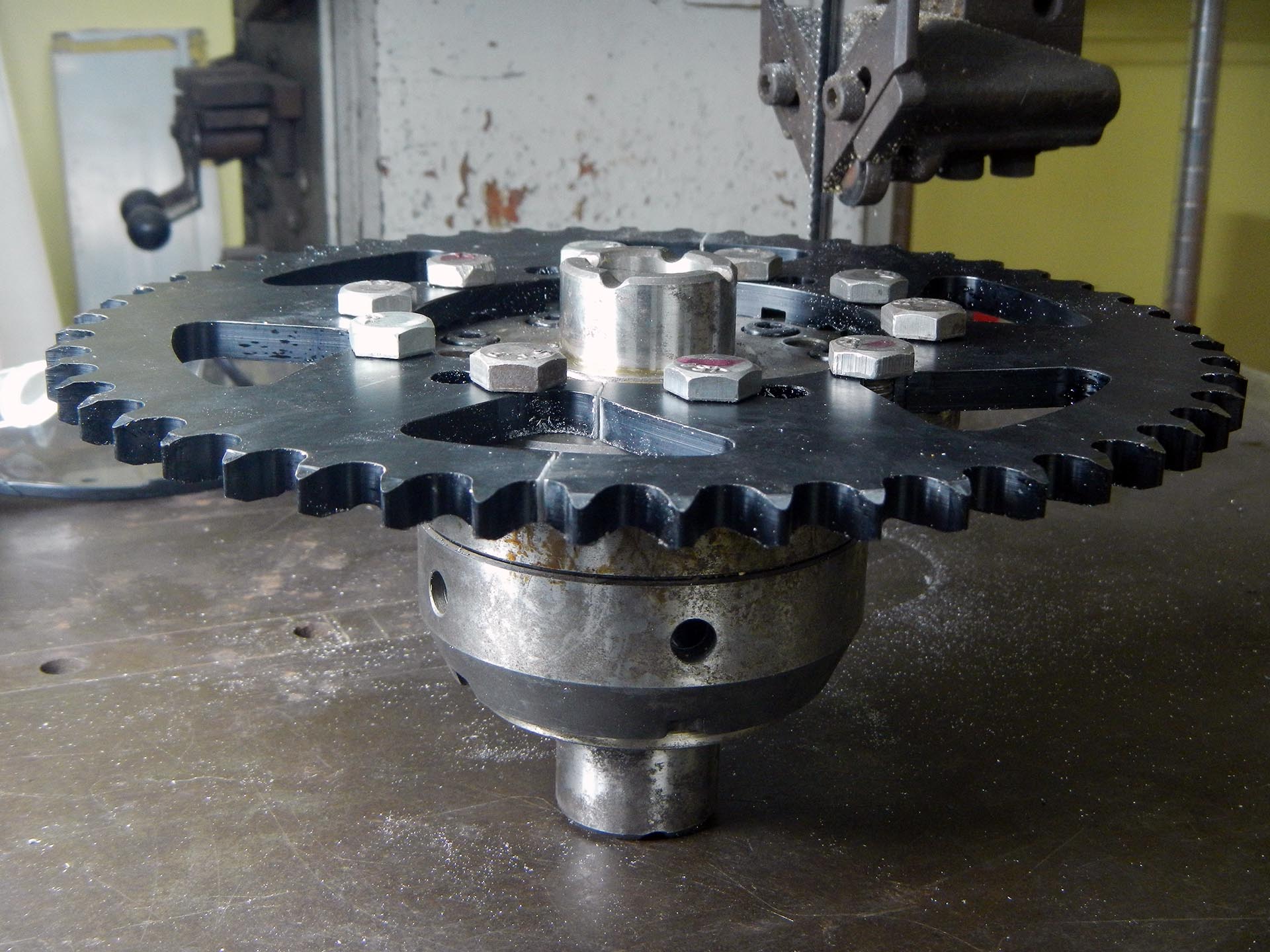
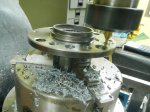
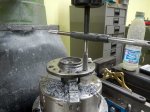
The limited-slip differential is a torsen or quaife type made by OBX, imported from the USA for an American-style Honda Civic. The differential ring gear on American Honda Civics is mounted with left-hand threaded bolts, so I blithely go down to the auto recycler here in Thailand and buy a differential for donor parts. Hmmmm… these bolts don’t fit. So I check carefully and find these differentials are sold in Thailand with right-hand threads! I go back to the auto recycler and ask for left-hand threaded bolts. They just look at me with that “crazy foreigner” look. OK, all we have to do is order some American-style bolts from Ebay US… There is exactly one listing on all of Ebay, and they don’t ship to Thailand! Plan B: drill the suckers out and use through-bolts.

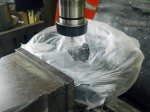
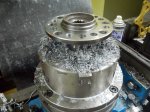
This is where I find out the differential housing is made of some ultra-hard tool steel, or maybe kryptonite or something. Wow, are these holes difficult to drill out. Solid carbide end mill, highest speed on the milling machine, lots of lubrication, and wait. And wait. And wait…

Next we had to drill a matching hole pattern in the rear sprocket, then cut it in two halves for quick changing at the track. This sprocket will be for static test only as the new hole pattern wasn’t compatible with the old one, leaving thin aluminum in some places. I’ve since ordered a blank rear sprocket from England which I will cut with only the correct holes.

Removable Engine-Compartment Frame Rail

My original plan was to make the engine install from the bottom as I’d owned Porsche 911s for most of my life, but feedback on the ApexSpeed.com forum made me change my mind. The change was fairly simple, requiring only making the upper right engine-compartment frame rail removable. Taking an angle grinder to cut a big chunk out of my finished frame definitely made me measure seven times, cut once.

Fabricating GSX-R1000 Engine Mounts

Sorry for the long delay since the last blog entry. A lot of water has gone under the bridge since then. But don’t worry, the project has continued, although with some big distractions. I’ll be trying to catch up on my blogging in the next few weeks.

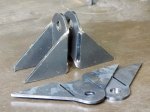
Next up is fabricating the engine mounts for the 2007-8 Suzuki GSX-R1000 motorcycle engine. I surveyed the state of amateur formula-car engine mounts, and decided a lot of them are inadequate. This video got me to thinking: https://www.youtube.com/watch?v=m1j7hmJmSJA as my car should be faster than a Ferrari 458. Some might be skeptical of that speed comparison; if you are, take a look at this comparison of a Porsche 911 Turbo versus a formula 4 car: https://www.youtube.com/watch?v=e8WyvVbVu4k . A formula 1000 car should compare favorably with a formula 4 car. Either way, you lose a lot of torsional rigidity with the large open hole to mount the engine, and I hope to recover much of that with a strong triangulated set of engine mounts.


Building a Workshop Gantry Crane

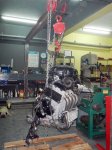
I need to be able to lift the engine into the chassis, but due to the lowered floor of the work area a standard engine lift won’t work. While I’m at it, it would be nice to be able to lift the entire assembled car off the build table, turn it ninety degrees, move it to the door, and roll it out of the shop. Below is the solution. Sorry there aren’t any plans. The build process was “go to your local metal recycling center, buy some scrap beams, clean them up, cut them as necessary, and weld them together”. I’m getting more comfortable with winging it in the machine shop.

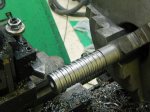
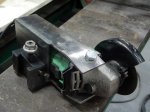
Also shown below is a mount I built to mount an angle grinder on the lathe. Parting-off has always been a problem. I’m just about to make the engine mounts, requiring at least 36 cutoff operations, and I figured I’d better solve the problem. I have a cutoff tool but only purchased a small number of carbide inserts; the inserts wear out really fast and I either have to order more from the US or drive at least an hour to a store that MIGHT have them. This baby works great, giving a clean straight cut. Just have to be careful not to let the abrasive get into the lathe.

Steering Column Supports

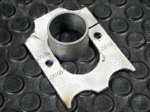
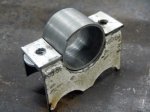
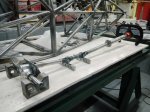
Next up: mount the steering column in the chassis. Nothing magical here, just lots of little steps. The steel bearing cup insert did work well at preventing distortion during welding. To get a proper press fit for the rear support bearing I decided to use my new internal bore gauge. At first it didn’t work at all (made in China, of course), so I had to disassemble it completely, figure out how it was supposed to work, unstick the rusted shaft, replace the dead battery, and reassemble it. All in a day’s work out here on the frontier. So now I can measure both holes and shafts to a few microns and press fits are much easier to make.

Fabricating the Steering Column

I originally sent all these parts out to the CNC shop, but they never got back to me with a quote so I ended up making everything myself. The spline onto the steering rack was a tight press fit, so for now the entire column including the rack is a single assembly. I don’t know it’s possible to remove the rack later, and I’m not going to try as it might destroy the rack. The U-joints are special units from Sweet Manufacturing in the US, but don’t seem to be anything special. In the future I might try to adapt standard Honda steering column U-joints and column splines. These use a perpendicular pinch bolt so the column can be disassembled at each joint.

Turning the Steering Rack Extensions

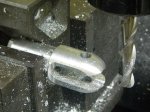
The ends of the steering rack have to be in line with a plane through the control arm attachment points, and unless you have a custom-made rack this will require extensions to each end of the rack. I got these made and then went to the local nut & bolt emporium, only to find they don’t carry 3/8-24 socket-head cap screws. I know, weird huh? Had to order them on Ebay in the US and am now keeping my fingers crossed that they will arrive (at all). I recently ordered some more left-handed nuts the same way and they arrived in eight days with no problems, so yay?

For these I had to dig into my precious stash of 7075 aluminum…

Modifying the Wheel Hubs & Axles

We’re using Honda Civic wheel hubs, wheel bearings, CV joints and axle halfshafts. They’re available everywhere, cheap, and light, and by using them we avoid having to cut matching pairs of splines. The wheel hubs are drilled for lightness and tapped to accept the wheel drive pins, then the two outermost pieces from two scrap CV joints are cut down to use as bearing retainers for the front wheels. Rear axle halfshafts are used in stock form, but extenders from the halfshafts to the differential will have to be fabricated later.
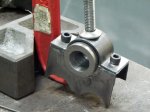
When cutting the CV joints I found that the contact faces are hardened some way into the joint, making cutting almost impossible (by which I mean “impossible”) beyond a certain point, even with carbide cutting tools. If they are heat-treated, maybe there’s some way to reverse the hardening? It’s probably something more exotic than that, though, as the hardening was highly location-specific.

Fabricating the Seat Bottom

Just a quick update here as the next one will be big and I want to keep it together as one post. I want to get all the tabs and brackets attached to the frame as soon as possible so I can paint it, so I started with an easy one: the seat bottom. I had the pieces laser cut, but the shop forgot that there are two identical side pieces and I had to cut that one by hand. I turned out to be easy after making a paper template. Each of the four pieces is a section of a cylinder and some of the edges intersect off-axis with frame tubes, so those lines that look straight really aren’t. The seat bottom is curved like this to get the driver as low as possible, mainly to keep the top of the main roll hoop as low as possible. The curvature was easy to make by just bending the steel by hand and fitting it by eye to the frame.

Attachment points are carefully spaced more than six inches from each other to comply with the F1000 rule outlawing stressed panels (with certain exceptions). It would have been much easier to just weld each piece to the frame tubes below it, but I don’t plan on this counting as the stressed belly pan. A stressed belly pan will be added to the planar bottom of the car. Making the seat bottom removable gives the advantage of easier access to the triangular compartment below it for mounting the fire extinguisher and whatever else will fit, and I can also replace the seat bottom later with a carbon fiber and kevlar version to save weight. At the moment I’m appreciating the fact that certain important body parts will be protected by two layers of steel in the event of a crash.