Removable Engine-Compartment Frame Rail

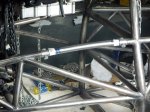
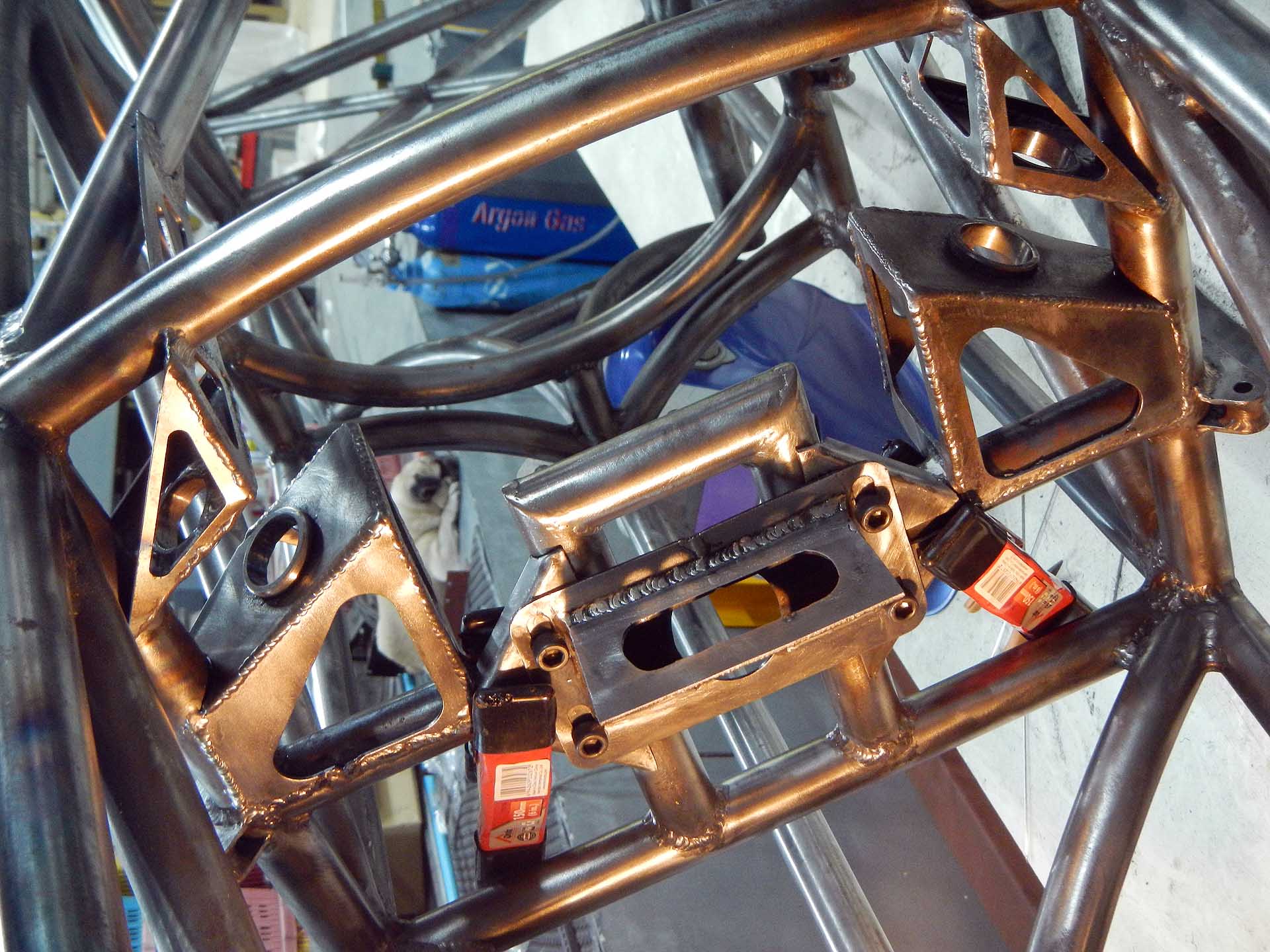
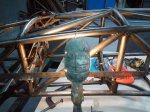
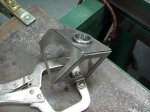
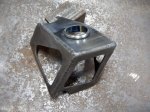
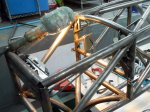
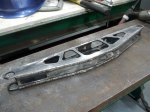
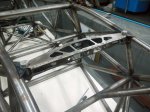
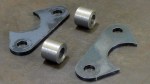
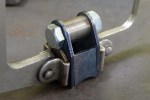
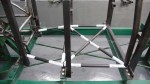
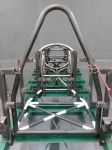
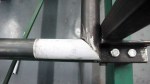
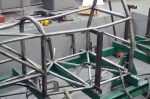
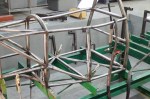
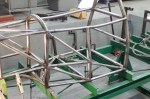
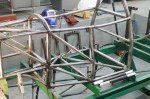
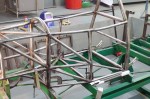
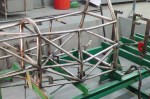
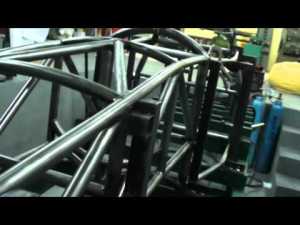
My original plan was to make the engine install from the bottom as I’d owned Porsche 911s for most of my life, but feedback on the ApexSpeed.com forum made me change my mind. The change was fairly simple, requiring only making the upper right engine-compartment frame rail removable. Taking an angle grinder to cut a big chunk out of my finished frame definitely made me measure seven times, cut once.

Fabricating GSX-R1000 Engine Mounts

Sorry for the long delay since the last blog entry. A lot of water has gone under the bridge since then. But don’t worry, the project has continued, although with some big distractions. I’ll be trying to catch up on my blogging in the next few weeks.

Next up is fabricating the engine mounts for the 2007-8 Suzuki GSX-R1000 motorcycle engine. I surveyed the state of amateur formula-car engine mounts, and decided a lot of them are inadequate. This video got me to thinking: https://www.youtube.com/watch?v=m1j7hmJmSJA as my car should be faster than a Ferrari 458. Some might be skeptical of that speed comparison; if you are, take a look at this comparison of a Porsche 911 Turbo versus a formula 4 car: https://www.youtube.com/watch?v=e8WyvVbVu4k . A formula 1000 car should compare favorably with a formula 4 car. Either way, you lose a lot of torsional rigidity with the large open hole to mount the engine, and I hope to recover much of that with a strong triangulated set of engine mounts.


Designing and Fabricating the Steering Rack Mount

Rack Mount

Steering rack mount, ready to weld gussets.

Next step in getting the car rolling is to mount the steering rack. These parts were not laser cut but were cut with angle grinders and my bandsaw, because they’re, um, a design improvement. Yeah, a design improvement, that’ll work. It took me months to find a blade for my bandsaw, because Thailand. Anyway, now it’s useful for these kinds of tasks.

Once again we have something that looks simple, but took a great deal of thinking to arrive at. As Steve Jobs said, “Simple can be harder than complex: You have to work hard to get your thinking clean to make it simple.” I used to do almost exactly what Steve Jobs did; in fact, he once called my boss to persuade him to cancel the design we were working on, because Jobs was going to do it better (he didn’t). So I understand precisely what Jobs meant about simplicity. That might help explain why this was my fifth complete design for this subassembly. One downside of mechanical design: when you’ve sweated out an elegant design, anybody can take a casual glance at it and say “OBviously”. To which I reply, “OK, there’s probably an even better design out there somewhere. Let’s see you find it.”

Also attached are a few of the finite element analysis (FEA) tests that I performed to verify and improve this design.

Rear Suspension Rocker Arm Mounts & Nose Mounts

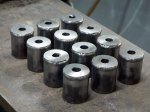
Rocker Bushing

Rear suspension rocker arm mount shaft bushing

Above you’ll see that my welding continues to improve, although slowly. In response to the deleted commenter of the day, yes, we do use dyslexic dwarfs to do our welding, but we get ours from Lithuania. Good guess, though!

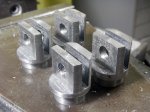
Next we have photos of the rear suspension rocker arm mounts. As these have to be positioned correctly in three dimensions and three axes, and none of those are X, Y, or Z, it took about a week to get these fabricated and fitted. Starting with laser-cut pieces proved useful as that gave me a known-good shape to start from, but some of the frame rails could be a few millimeters off. Also, every time I weld on something it distorts. Both halves of the rocker arm mounts must be precisely concentric and exactly the correct distance apart. Unfortunately they are not connected directly to each other in order to allow for rocker arm movement between them so there’s plenty of opportunity for them to move, even though I did the welding with the rocker arm shafts in place. In the photo with the control arms installed, you’ll see one answer to that: a long piece of steel rebar turned to fit inside the rocker arm shaft bores. Pounding on that with a rubber mallet would move the bores back into alignment a bit at a time.

Also, nose mounts. In the end these look terribly simple, but it took me a lot of thinking about how to do this. They have to be strong enough in one direction to lift the nose of the car with a pivoting jack, and in the other direction they have to support the downforce of the front wing. Also, they can’t protrude or be sharp so as not to injure another driver in a crash while taking the tremendous force of a forward impact, and have to allow the nose to be adjusted in three dimensions and two axes for proper body fit. Body installation begins here; the rest of the body will be keyed off the nose.
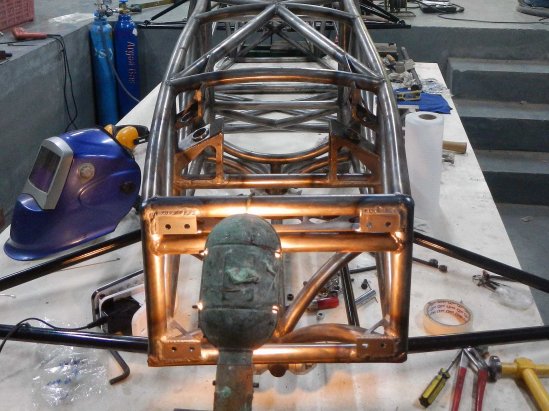
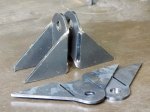
Nose Mounts

Nose attachment points laser cut and welded in place.

Fabricating the Pushrods & Upper A-Arms / Wishbones / Control Arms

Finished

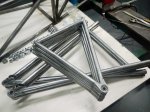
Finished set of control arms, tierods & pushrods

The upper control arms are all identical except that the bearing cups are mirrored from the left to the right so that the snap rings are on the bottom. If I can find a way to stake the spherical bearings then all four could be identical. Staking is a process that uses a hydraulic press to deform the bearing cup into a chamfer around the circumference of the spherical bearing, holding it permanently in place.
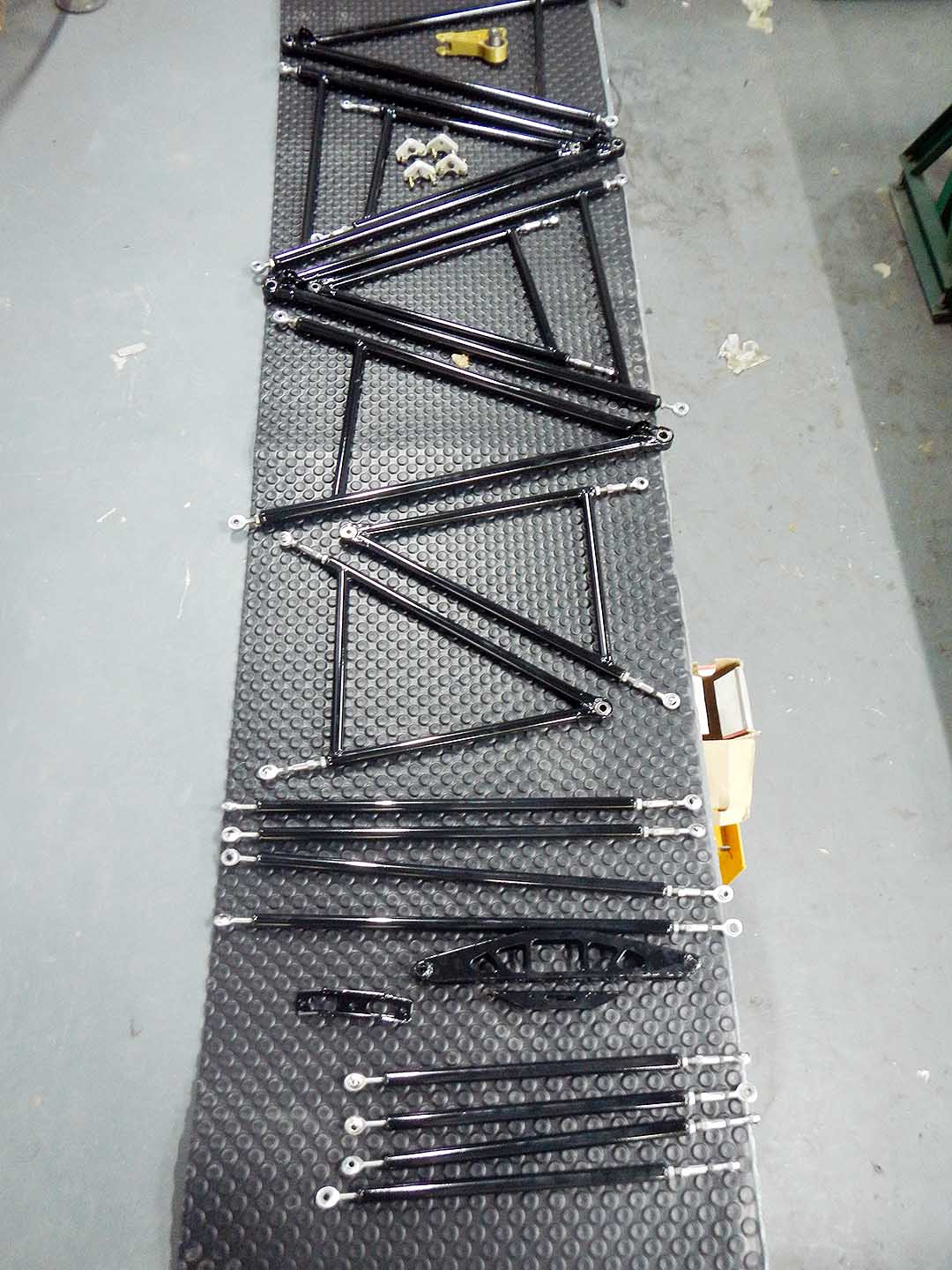
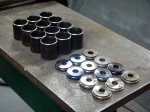
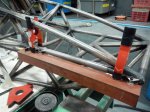
I printed out the layout of both control arms onto size A0 paper, glued the paper to a sheet of plywood, and drilled holes for the centerlines of each rod end and spherical bearing. This gives me a jig I can use for tack welding the parts in place. Washers under the bearing cups locate them vertically for tacking. The bearing cups proved a little too thin to weld without distortion, so I had to re-cut the spherical bearing bores after welding. Luckily I have an indexable end mill of just the right diameter, and running my mill at high speed with a lot of coolant gave a good finish on the bores. I then pressed the spherical bearings into place before painting as I wanted to make sure there were no glitches that would require messing up the paint to fix.

I sprayed Jotun Penguard 2-part epoxy paint directly onto the steel after first making sure the steel was scrupulously clean with a Scotchbrite pad on an angle grinder, followed by a cleaning with acetone and paper towels. The finish came out beautifully.

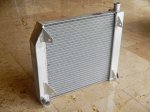
Custom Radiator, Lathe Cooling, Suspension Progress

Time for a few miscellaneous updates.

Lathe Coolant

Homemade lathe liquid coolant system

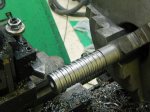
I was always dreading having to machine steel. I had to do it  slowly to keep the temperature down and avoid chatter, even though I use carbide cutter inserts. Then I read somewhere that home hobbyists tend to be afraid to run the lathe & milling machine at high enough RPM to keep the cutting inserts happy, but  if they do it will cause the insert to overheat and be cooked in two seconds. I figured I can find the cojones to run my equipment at maximum speed as well as the next guy…

So one day I was browsing at my new favorite store, Hardware House in Rayong, and I saw a gallon container of cutting coolant fluid for sale. I’d had no idea of how to find this stuff in Thailand, or even how to ask for it, so it was pure luck to stumble over it. Or you could call it diligence in going up and down every aisle in Hardware House looking for things I might need. They also had flexible fluid squirters and 12-volt water pumps, so I put together my own fluid cooling system, pictured above. I drive the pump with an automotive battery charger which allows me to reduce the voltage and amperage to get the correct flow, and it works like a charm! Now I can cut steel like I used to cut aluminum.
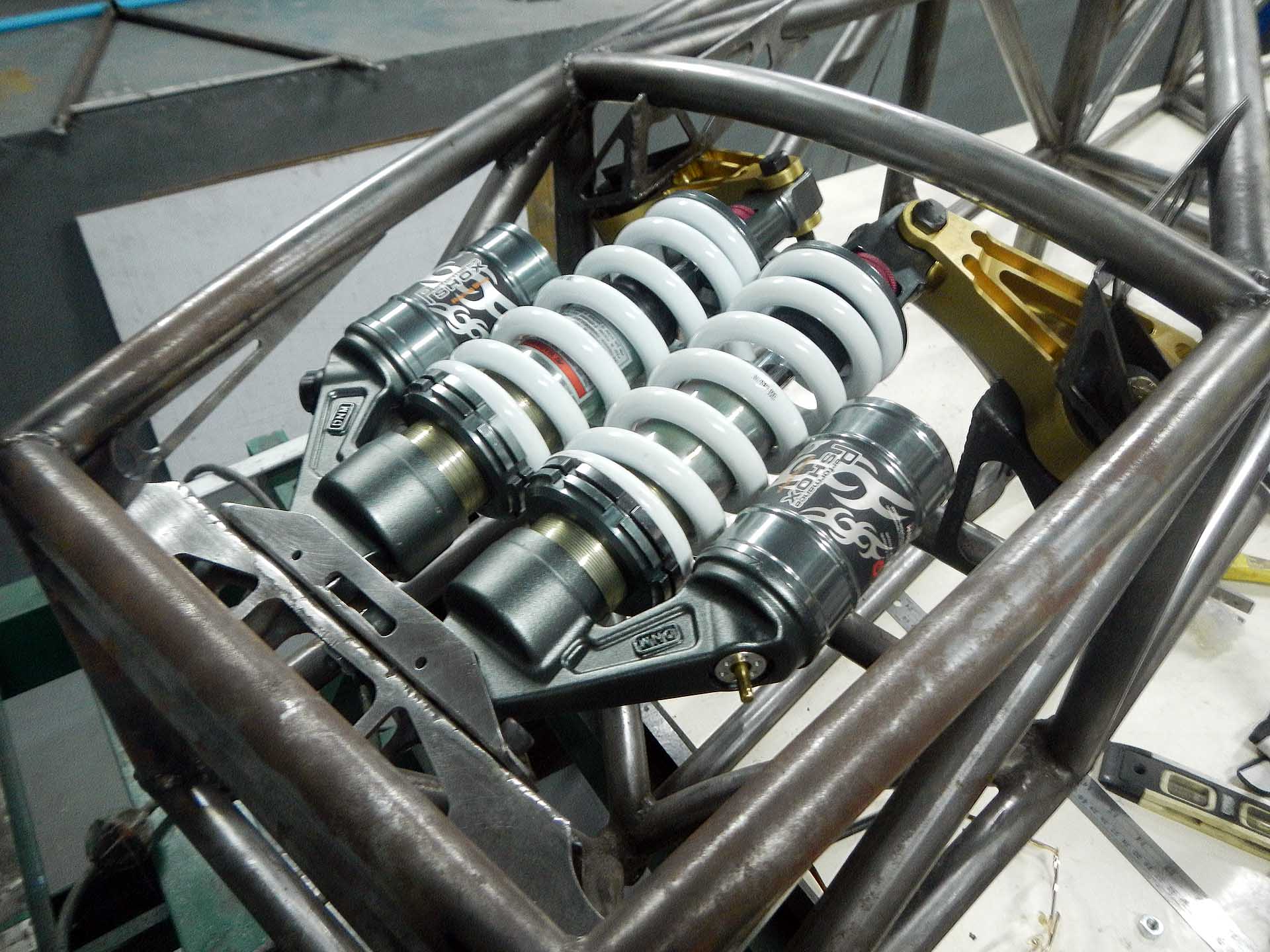
Front Shocks

Front shocks, shock mount, and rocker arms test fitted

First Laser-Cut Parts

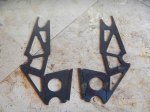
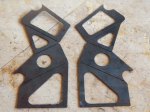
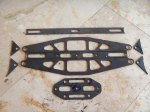
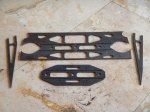
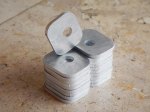
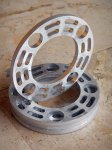
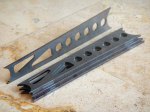
Below is our proof-of-concept for laser cutting parts in Thailand. Choices of material are extremely limited– ya got yer steel, see, and ya got yer aluminum. Unfortunately the aluminum is 1100, which has the structural strength of mozzarella, so I had to provide my own 6061-T6 to be cut. That didn’t reduce the price much, though. Redesigned some parts to match the available steel, which luckily is considerably stronger than cheese. I don’t yet have a sheet metal bender or supplier, so some parts have a slot cut where they are bent by hand and welded to shape as seen in the last photographs.

Fabricating the Suspension Attachment Points

Building the Cockpit

Time for a photo update showing how I built the cockpit, tube by tube.